

Shipping Costs
How to Get Accurate Vehicle Shipping Quotes
Stop guessing shipping costs. Get clear, accurate car shipping quotes with Revoway - no surprises, just honest prices from verified carriers. Get a quote today!

Mike Hovhannisyan
11 Nov 25
Ship your RV with confidence! Learn costs, timelines & the process. Get a free RV shipping quote from Revoway today.

Click the button to start! We are here to be part of your car shipping story. Let's create a lot to tell!
Movies and travel shows make RV life look effortless. What you see is the open roads, the changing views, and the freedom to take home with you everywhere you want to go. Maybe you have always wanted that life, or perhaps you simply want to know what it involves. The reality is less simple. RVs are expensive, oversized vehicles, and driving one across several states is not always practical. Owners often ship them when relocating, buying from another state, traveling to a seasonal destination, or avoiding fuel costs, wear, mileage, and a demanding drive. RV shipping differs from standard car transport because size, weight, height, condition, route, and access affect the equipment, price, and planning required.
RV shipping is the professional movement of a motorhome, travel trailer, fifth wheel, camper, or park model. Depending on the unit, it may be driven, towed, loaded onto a flatbed, or carried on specialized commercial equipment. Driving may make sense when the RV is roadworthy, the owner is confident, and the journey is part of the trip. Shipping with an auto transport company is often better when time is limited, the distance is long, the unit is not roadworthy, or added mileage would reduce its shipping costs.
RV shipping often costs about $1.50 to $5 per mile, although large or complicated moves can cost more. Cross-country shipments may range from a few thousand dollars to $7,000 or higher. Distance matters, but so do the RV's class, dimensions, weight, condition, route, and transport method. A Class B camper van is usually easier to move than a Class A motorhome. Large fifth wheels, park models, and oversized units may need heavy-duty equipment, permits, route surveys, or escort vehicles. Rural pickups, narrow campgrounds, mountain roads, seasonal demand, fuel prices, and urgent dates can also raise the quote.
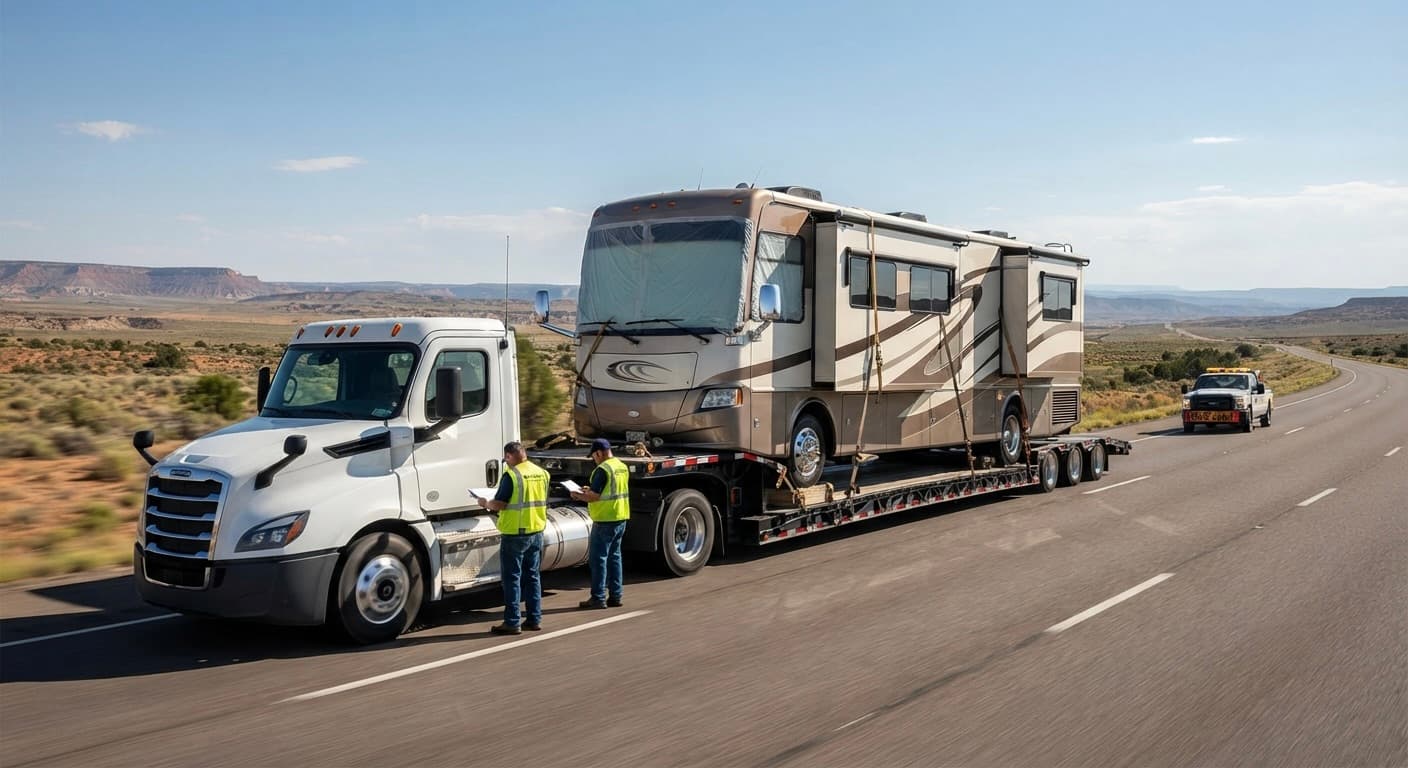
Drive-away service uses a professional driver to operate a roadworthy motorhome. It adds mileage and normal wear. Tow-away transport is used for travel trailers, fifth wheels, and campers. It is often affordable, but the hitch, brakes, tires, lights, bearings, and suspension must be safe. Flatbed transport places the entire RV on a trailer. It suits non-running or high-value units and prevents road wear, but costs more. Very large units may require lowboys, step-decks, permits, restricted travel hours, and pilot vehicles.
Start by providing the RV's year, model, exact dimensions, weight, condition, locations, and preferred dates. State whether it can be driven, towed, or loaded safely. Compare companies by more than price. Ask whether each is a broker or carrier, which method it will use, what insurance applies, and whether permits, tolls, escorts, and extra fees are included. After booking, expect the carrier's details, pickup window, delivery estimate, and updates about delays.
Remove valuables and prohibited items—secure cabinets, appliances, doors, windows, furniture, and loose objects. Retract awnings and slide-outs. Disconnect water, power, and propane as instructed. Empty the refrigerator and holding tanks when required. Secure batteries and switch off unnecessary electrical systems. For driven or towed RVs, check tires, brakes, lights, fluids, suspension, hitch equipment, and safety chains. Secure exterior accessories. Clean the RV enough to reveal damage, then photograph every side, the roof where safe, windows, wheels, hitch, and existing defects.
At pickup, inspect the RV with the driver. Record every existing defect on the Bill of Lading, review the notes before signing, and keep a copy. At delivery, inspect the RV again before signing or paying the final balance. Compare it with the pickup report and photographs. Check the body, roof, windows, tires, hitch, attachments, and interior. Write any new damage on the delivery Bill of Lading, photograph it, and ask the driver to initial the notation. A clean signature may be treated as confirmation that the RV arrived satisfactorily.
Low bridges, narrow roads, weather, permit requirements, and difficult addresses can delay transport. Provide exact measurements and honest access details so the carrier can plan the route and equipment. Even choosing between enclosed or open auto transport can be a challenge.
Verify the company's USDOT and MC numbers, operating authority, legal name, phone number, and address. Ask for proof of insurance and confirm that the limits suit your RV. Look for experience with your RV class, not only standard cars. Compare reviews across several platforms and watch for repeated complaints about price increases, poor communication, damage, or missed pickups. The cheapest quote is not always the best. Choose the company that understands the RV, route, equipment, access, and legal requirements before pickup.
RV shipping requires more planning than standard auto transport, but it need not be complicated. Accurate measurements, the right method, careful preparation, clear inspection records, and an experienced carrier prevent most problems. Understand the cost, verify the company, prepare the RV, and document its condition at both ends. Those steps give you the best chance of a smooth shipment and save the driving for the part of RV life you wanted.
RV shipping often costs $1.50 to $5 per mile.
Most carriers limit or prohibit them.
It may take several days to several weeks.
Usually, but verify the limits and exclusions.
Drive-away suits roadworthy units; flatbed transport avoids added mileage.
Stop guessing shipping costs. Get clear, accurate car shipping quotes with Revoway - no surprises, just honest prices from verified carriers. Get a quote today!
11 Nov 25

Discover 12 hidden factors that affect car shipping costs beyond distance. Learn how seasonality, routes, vehicle condition, and more influence prices.
27 Sep 25