

Guides for First-Time Customers
International & Overseas Car Shipping: Costs, Ports, and Documents Explained
Shipping a car overseas? Learn costs, ports, and required documents. Learn more!

Hayk Baghdasaryan
02 Oct 26
19 August 2026
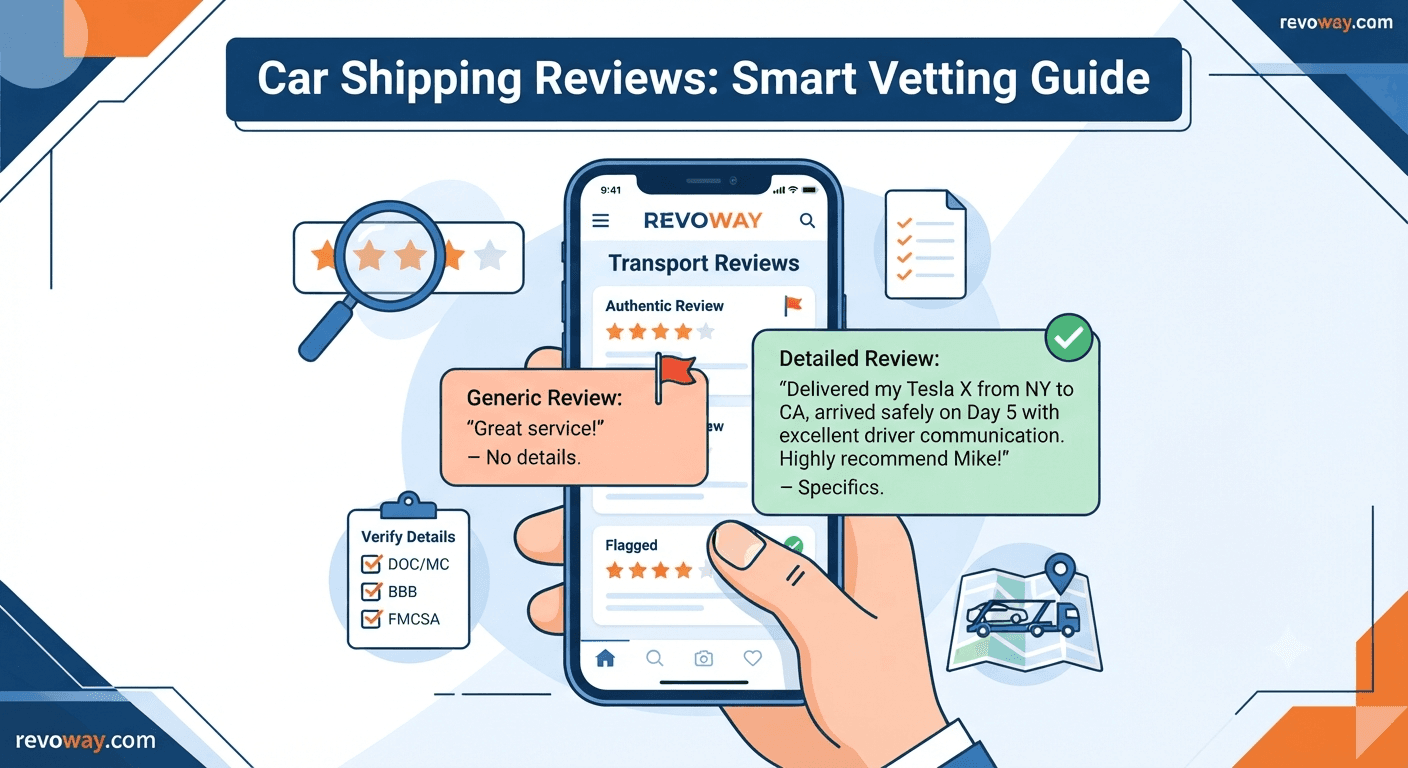
Learn how to read car shipping reviews, spot fake ratings, and avoid unreliable auto transport companies.

Click the button to start! We are here to be part of your car shipping story. Let's create a lot to tell!
According to BrightLocal's Local Consumer Review Survey (2025), 93% of consumers say online reviews influence their buying decisions. And in the past few decades, online reviews and testimonials have been key drivers in helping vehicle owners choose an auto transport service. Unfortunately, not every review tells the whole story. Fake profiles, manipulated testimonials, and artificially inflated ratings make it difficult to tell which transport company is reliable. The good news is that when you know the right things to look out for, you can easily spot the misleading ones and avoid them.
In this article, you will get a clear breakdown of where to find legitimate reviews, how to spot fake ones, and other necessary info you need to know to avoid scammers disguised as legitimate auto carriers. Let’s dive in.
Review platforms do not tell the whole story when you are seeking reliable auto transport carriers. The best course of action is to compare reviews from multiple independent sources and verify the company's FMCSA registration and BBB profile. At Revoway, we also recommend that car owners read reviews in addition to considering the ratings.
Confirm the company's DOC/MC number before booking.
Below are platforms you can trust:
A company with 5-star reviews can still have unresolved customer complaints and issues. So, BBB helps you review these aspects to make an informed decision. Use all platforms, not just one.
Facebook and Yelp are also good places to look. Still, Facebook reviews can be easily doctored, and Yelp has low review volume because most customers ship their vehicles only once a year, resulting in a small number of experiences.
Online reviews help you make sound purchasing decisions, but not all reviews are genuine. The U.S. Federal Trade Commission (FTC) now prohibits businesses from buying or selling reviews, as they're clearly misleading to the general public.
Here are the biggest warning signs to watch out for:
An authentic review will typically mention specifics such as the following:
Fake reviews often rely on the following:
If a company receives a flood of 5-star ratings within a few days, weeks, or after a month of activity, it needs scrutiny.
Click on the reviewer's profile.
These are your metrics.
Real customers generally describe their experiences. But the fake ones often go overboard to praise and sound salesy. For example:
“The best auto transport company in New York. I always recommend them."
You saw a five-star rating on their website but a review highlighting a problem.
Not even a minor criticism. Genuine feedback often highlights lapses or oversights from the auto transport carriers' end.
Any suspicious review deserves attention and further investigation to uncover the truth and resolve doubts.
Because not every five-star review is reliable, you need to understand how to spot credible auto transport reviews to help you judge whether a carrier or broker consistently delivers on its promise.
Here are the simple indicators.
Genuine reviews don't fabricate shipment details. They tell experiences that include the following:
You can tell the difference between a generic "Great company. Wonderful service" and “Mike (the carrier) picked up my 2024 Toyota Camry in Atlanta on Tuesday and delivered it to Denver on Friday with damage.”
Authentic reviews often don't describe a service as perfect. They state:
One solid trust signal is a steady flow of reviews over months and years—not dozens appearing out of nowhere over the weekend or within a few days.
In the first section of the article, cross-platform review checking was highlighted. One platform is not enough credibility signal. You need to get consistent reviews on two (2) to three (3) more platforms such as Google Reviews, Better Business Bureau (BBB), Transport Reviews, and ConsumerAffairs.
Trustworthy auto transport companies respond professionally to both negative and positive reviews. They drop thoughtful, honest responses that explain the reasons for delays, take responsibility, apologize for any inconvenience, and outline a practical step to improve their services in areas where they're lacking.
Negative reviews are your most valuable resources for vetting a prospective auto company because they reveal their performance in real time. Watch out for:
You can also leverage reviews to evaluate an auto company when using them to guide your questions. Reviews should help you identify patterns about a carrier or broker before booking.
According to the Federal Motor Carrier Safety Administration, consumers should verify a company's credentials, insurance, and complaint history rather than relying on online ratings alone.
Here is how to use the reviews to ask questions before booking:
Significantly, you ask these questions before booking.
The truth is in the numbers, and the number of reviews matters. But review quality, consistency, and recency are stronger indicators of an auto company's reliability—not just volume.
According to the 2025 BrightLocal Local Consumer Review Survey, 89% of consumers expect businesses to respond to reviews, while 84% pay attention to recent reviews.
Recent reviews are absolutely important metrics. Say a company earned a review three years ago; ownership or management might have changed. For this reason and more, pay attention to the last 6–12 months of reviews for consistent patterns rather than isolated praises or complaints.
Bottom line: Don’t ask, “How many reviews does this company have?” Instead, ask:
Reviews are significantly useful for choosing the right auto transport company if you know how to read and use them.
Crosschecking reviews across multiple certified platforms, pattern recognition, and direct follow-up give you the clearest understanding of a company's reputation and reliability.
Taking even 20 minutes to research reviews before booking an auto transport can prevent fundamentally costly mistakes.
The following review sites are the most reliable for vetting car shipping companies: Google Reviews, Better Business Bureau (BBB), Transport Reviews, and ConsumerAffairs.
You can easily tell if a car shipping review is fake by cross-checking its consistency across multiple verified platforms, researching the reviewer, checking recency (a flood of mostly positive reviews in a few weeks is likely fake), and seeing whether all reviews are positive.
Look for evasiveness, dismissiveness, and denial of claims. Also, when they're not addressing the issue but only saying, "Contact customer service."
No. Reviews say a lot more than ratings. Study the reviews before committing your vehicle.
You can leave a review on the carriers' websites, general consumer review platforms, and transport review sites.
Shipping a car overseas? Learn costs, ports, and required documents. Learn more!
02 Oct 26
A corporate relocation car-shipping guide for companies. Get a free quote from Revoway for seamless employee moves.
29 Sep 26