

Guides for First-Time Customers
How to Ship a Car Bought at Auction (Copart, Manheim, Adesa, IAA)
Won a bid at Copart, Manheim, or IAA? Here's how to ship it home fast. Learn more!!

Mike Hovhannisyan
05 Oct 26
26 August 2026
Learn what a normal car shipping deposit looks like and how to spot and avoid common deposit scams.
Guides for First-Time Customers

Click the button to start! We are here to be part of your car shipping story. Let's create a lot to tell!
You are ready to lock in a quote to ship your car. The price looks solid, the agent on the phone was super nice, and you are feeling pretty good about the whole thing. Then comes the phrase: "Alright, we just need a quick deposit to hold your spot." Suddenly, your internal alarm goes off. Is this normal? Are they asking for too much? Is my money about to vanish into thin air? If your stomach took a quick dip, do not worry, you are not alone! Deposits are completely standard in the auto transport world, but they are also the primary trapdoor scammers use to snag your hard-earned cash.
Let us clear the air. Here is everything you need to know about what a normal deposit looks like, the red flags to watch out for, and how to keep your money safe.
Think of an auto shipping broker like a real estate agent for your car. They do not usually own the big car haulers you see on the highway. Instead, they do the heavy lifting of finding a vetted, insured truck driver who is actually heading your way.
Here is how the money flow usually works:
This setup keeps everyone honest. If a company demands 100% of the money upfront before they have even found a driver, run!
So, how much cash are we talking about?
For a standard cross-country move, a typical deposit ranges between $50 and $250, depending on the total cost of the route. It is basically the broker's commission for coordinating the logistics.
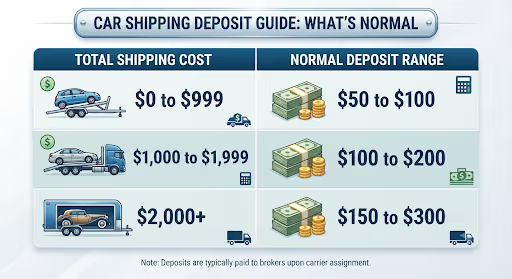
An infographic titled "CAR SHIPPING DEPOSIT GUIDE: WHAT'S NORMAL" presented as a three-row table. The left column, "TOTAL SHIPPING COST," shows ranges: "$0 to $999," "$1,000 to $1,999," and "$2,000+," each with a corresponding icon of a car on a trailer, a standard hauler, and an enclosed hauler. The right column, "NORMAL DEPOSIT RANGE," shows the corresponding deposit amounts: "$50 to $100," "$100 to $200," and "$150 to $300," each accompanied by stacks of cash and coins. A footer note reads: "Note: Deposits are typically paid to brokers upon carrier assignment."
Here are two massive red flags to keep on your radar:
Here is where things can get a little sticky. Is a deposit ever refundable?
Rule of Thumb: A deposit should ALWAYS be 100% refundable up until the moment a carrier is officially assigned to your vehicle.
If a broker has not reserved a spot on a truck for you yet, they have not earned that deposit. If you cancel before a driver is dispatched, you deserve every penny back.
Once a driver is assigned and route plans are set, the deposit usually becomes non-refundable because the company locked in real labor and space for you. That is totally fair, as long as it is clearly written in your contract.
Never accept verbal promises over the phone like, "Oh yeah, do not worry, we will refund you if you change your mind!" Get it in writing, or it did not happen!
Scammers in this industry can be pretty clever, but they usually play the same broken record. Watch out for these three big ones:
A company quotes you an insanely low price to get you hooked. You pay a $200 deposit. A day before your car is supposed to be picked up, they call you weeping: "Oh no! Truck prices went up! It is going to cost another $800, or you lose your deposit."
You find a company online, pay a quick $300 deposit, and get a pretty confirmation email. Pickup day arrives, and nobody shows up. You call the number, click, disconnected. Your money is gone, and so is the company.
Shady actors create slick websites that look identical to trusted industry giants. You think you are booking with a famous transport brand, but you are actually feeding your credit card info to a scammer sitting halfway across the globe.
Before you hand over your payment details, put on your detective hat and run through this quick safety checklist:
First off, take a deep breath. It happens to the best of us! If you realize you have handed cash to a scammer, act fast:
Deposits are not evil, they are just part of how the car shipping engine turns! A great company will treat your deposit with complete transparency, give you straight answers, and hand over their license credentials without throwing a fit. Take five minutes to double-check their stats before you pay, and you will enjoy a stress-free ride! We will be more than happy to help you, contact us now!
A standard deposit typically runs between $50 and $250, depending on the total route cost. It usually is not charged until a driver is locked in for your vehicle.
Yes! In fact, a credit card is the safest way to pay because it offers consumer chargeback protection if the company turns out to be fake.
Check your signed contract first. If they violated their own cancellation terms or never assigned a driver, contact your card issuer to dispute the charge immediately.
Ask for their MC or USDOT number and look them up on the FMCSA's official company search portal. Also, check their BBB rating and independent customer reviews.
Some brokers offer no upfront deposit options where you pay nothing until the truck is assigned or even picked up, but almost all shipments require the balance to be settled upon delivery.
Won a bid at Copart, Manheim, or IAA? Here's how to ship it home fast. Learn more!!
05 Oct 26
Shipping a car overseas? Learn costs, ports, and required documents. Learn more!
02 Oct 26